Best Pickleball Paddle for Advanced Players (2026): Control, Value, Attack
Paddles
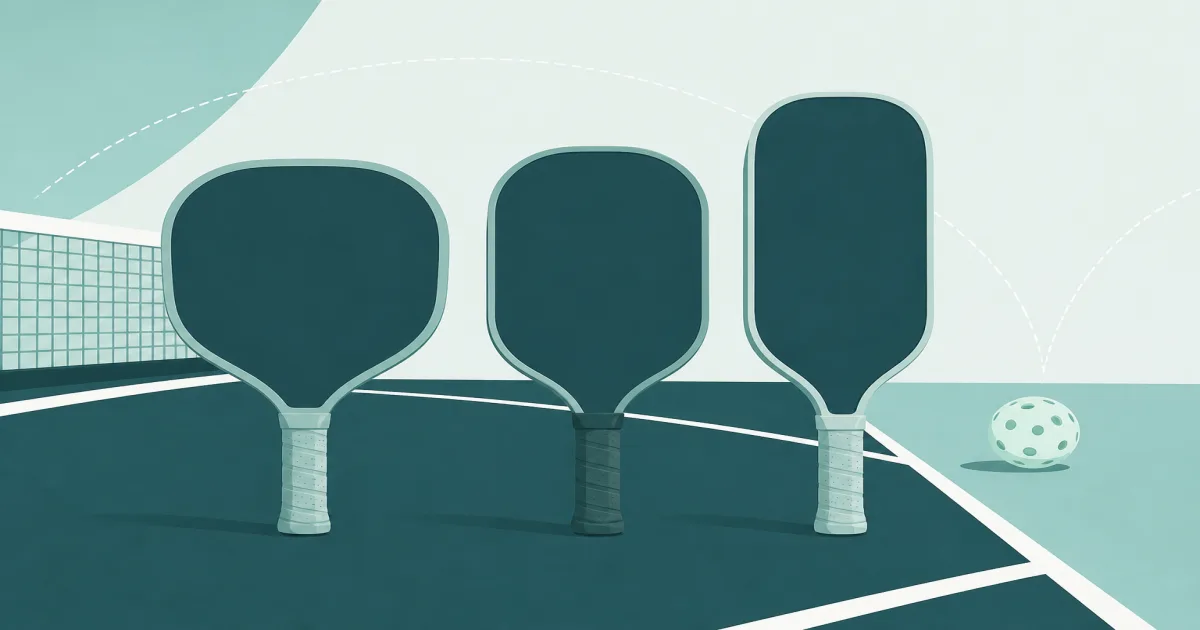
Advanced players need a paddle that matches a real role, not a vague premium upgrade. These three picks cover soft-game control, carbon value, and elongated attacking speed.
Our picks
The best pickleball paddle for advanced players should make one clear part of your game more dependable. A longer feature list is not enough. You need a shape, core, and ball exit that fit the shots you hit under pressure: resets, blocks, and drops, or drives, counters, and serves.
Browse more paddle guides in the paddles category, then use the best pickleball paddles pillar when you want an all-court shortlist. This page stays narrower: three differentiated winners for players who already find center contact and know whether they need more control, more value, or more attacking speed.
What actually changes at the advanced level?
What changes is that the miss you keep making costs more points, so the paddle should shrink that specific miss instead of adding a general upgrade. Shape, core thickness, handle length, and sweet-spot margin decide that tradeoff.
Match the paddle to the miss, not the marketing
If balls fly long, a livelier face makes that miss larger. If blocks die short, a firmer or faster face can help. Shape, core thickness, and handle length matter more than a branded technology paragraph.
The LUXX is a thick, quiet control specialist. The Prism 16mm is raw-carbon control for less money. The Hyperion 3 is the faster, more demanding elongated option. Three expensive paddles that feel the same will not help you, which is why the picks here cover three different roles.
Swing weight beats the number on the scale
Two paddles can both weigh about 8 ounces and swing very differently, because where the mass sits changes how fast your hands move. A head-heavy paddle adds stability and drive depth, and it slows your hands during fast kitchen exchanges.
Advanced doubles players usually want enough mass to stay stable and not so much that their hands lag. Weighing the paddle is the easy part. Feeling where the weight sits is the part that decides whether it suits your game.
Handle length is a real tradeoff
Plan on roughly 5.25 inches of handle before you commit to a two-handed backhand. A longer handle adds reach and off-hand room, and it takes face area from somewhere else. Do not pay for handle length you will never use.
Which advanced paddle should you buy?
Buy the Selkirk LUXX Control for resets and placement, the Vatic Pro Prism 16mm for carbon control at a lower price, or the JOOLA Hyperion 3 for attacking speed and a long handle.
None of these is a starter paddle. If depth control is still random, a hotter face makes the problem larger, and the intermediate guide is the better next read.
Selkirk LUXX Control: the control specialist
The Selkirk Sport LUXX Control Pickleball Paddle is the easiest recommendation for an advanced player who values soft-game consistency. Its thick control build and carbon face are designed around dwell time and placement. The broader face gives blocks and defensive resets useful margin when the ball arrives hot.
This suits a right-side doubles player who absorbs pace, keeps third shots low, and moves opponents before choosing an attack. It will not turn a compact swing into a heavy drive. Players who already create their own speed are the ones who appreciate the soft response.
Choose it if: You already generate enough pace and want better control on drops, resets, blocks, and angled dinks.
Skip it if: You need the paddle to add speed to compact swings or you prefer a crisp, direct response.
Check the Selkirk LUXX Control on Amazon
Vatic Pro Prism Carbon Fiber 16mm: the control value
The Vatic Pro Prism Carbon Fiber 16mm is the value choice for players who want raw-carbon control without a premium price. Its 16 mm core, T700 carbon face, cold-molded construction, and foam-injected walls aim for a calm response with useful spin and stability. A cover in the box is a practical bonus for players who rotate paddles.
That response works for players who value drops, resets, blocks, and shaped serves but do not want the very muted feel of a thick soft-game specialist. You still need to generate pace, and the 16 mm build is less demanding than the LUXX on deep drives.
Choose it if: You want forgiving carbon control, useful spin, and a proven ownership history near the mid-price lane.
Skip it if: You want the fastest possible ball exit or a full two-handed grip on every backhand.
Check the Vatic Pro Prism Carbon Fiber 16mm on Amazon
JOOLA Ben Johns Hyperion 3: the attacking pick
The JOOLA Ben Johns Hyperion 3 is the attacking pick. Its elongated Aero Curve shape, long handle, carbon face, and Propulsion Core are intended to increase swing speed and give the ball a faster exit. The listing puts it at 16.5 inches long, 7.5 inches wide, 8 ounces, with a 5.5 inch grip, which is the longest handle of the three picks here. It suits players who initiate with drives, counters, speedups, and heavy serves.
There is a noticeable adjustment period. Drives can fly long until you learn the quicker response. This is the most expensive pick here, and it asks the most from your technique. Extra pop is useful only if your contact point and paddle angle are repeatable.
Choose it if: You attack early, use a two-handed backhand, and can manage a lively face without giving away soft-game consistency.
Skip it if: Your common miss is long or you want a large, forgiving block surface.
Check the JOOLA Ben Johns Hyperion 3 on Amazon
Does court geometry favor control or power?
A pickleball court is only 20 feet wide and 44 feet long, with a 7 foot non-volley zone, so most points are decided inside a small box where resets and placement matter as much as pace. The net is 34 inches at the center, which keeps the ball low and rewards touch.
That geometry is why the control lane is not the boring lane. You have less room to hit through an opponent than a tennis player does, and the 7 foot kitchen gives a defender a real chance to absorb a hard ball and reset it. A paddle that helps you keep the ball low and place it beats a paddle that only adds speed, until your soft game is genuinely reliable.
Power still wins points. It just wins them later, once your drops and resets hold up under pressure. That is the order most advanced players should upgrade in.
What should an advanced player check before buying?
Start with swing weight and balance, not static weight alone. Check handle length before choosing an elongated model, think honestly about your miss, and confirm tournament approval for the exact generation.
Confirm the approval on the exact model
Approval status can change, especially with newer power constructions. Check the official equipment list before a sanctioned event instead of relying on a listing bullet or an older review. Model generations move fast at this price, and the name on the page is not always the generation in the cart.
What does each price band actually buy?
Spend is only useful when it maps to a specific change in feel. Strong options start near $100, and specialized premium paddles often land between $150 and $250.
The middle band is the one most advanced players should shop first. The top band only pays off when your contact point is repeatable.
Change one variable at a time
If you add tape, replace the grip, and switch shape on day one, you will not know which change helped. Play several normal sessions with the stock setup first, then tune one thing.
For the wider decision, compare the control lane against the power lane, and use how to choose a pickleball paddle as the checklist. If reach is the only thing missing, the elongated shortlist is the faster route.
Common buying mistakes
Buying the paddle used by the strongest player at your club. That player may have different timing, strength, grip, and court responsibilities. Copy the decision criteria, not the logo.
Treating price as a skill rating. A $250 paddle is not automatically an advanced paddle. Premium materials can still be wrong for your contact point or preferred response.
Changing too many variables at once. Play the stock setup before you tune.
Ignoring the return window. Advanced paddles can feel excellent in warm-up and frustrating under pressure, so keep the packaging until you have tested the shots that matter.
Expecting equipment to fix selection. A faster paddle cannot make a poor speedup smart, and a control paddle cannot replace early preparation.
Bottom line
The Selkirk Sport LUXX Control with the X7 core is our best pickleball paddle for advanced players who prioritize touch, defense, and point construction. Its soft control feel gives skilled players room to absorb pace and place the next ball.
Choose the Vatic Pro Prism Carbon Fiber 16mm when you want proven carbon control at a lower price. Move to the JOOLA Ben Johns Hyperion 3 when attacking speed, handle length, and a lively response fit how you already play. Do not buy the most aggressive option simply because it sounds more advanced. The right paddle makes your reliable shots easier to repeat and your common mistakes less expensive.
Frequently Asked Questions
What is the best pickleball paddle for advanced players?
For most advanced doubles players who build points with touch, start with the Selkirk Sport LUXX Control with the X7 core. Choose the Vatic Pro Prism Carbon Fiber 16mm for similar control priorities at a lower price. Move to the JOOLA Ben Johns Hyperion 3 when attacking speed, elongated reach, and a long handle match how you already play.
Does swing weight matter more than static weight?
Yes at this level. Two paddles can both weigh about 8 ounces and swing very differently, because where the mass sits changes how fast your hands move. A head-heavy paddle adds stability and drive depth, and it also slows you down in fast kitchen exchanges.
How long should the handle be for a two-handed backhand?
Plan on roughly 5.25 inches of handle before you commit to a two-handed grip. A longer handle adds reach and off-hand room, and it takes face area from somewhere else, so do not pay for it unless you use it.
Should an advanced player buy a power paddle or a control paddle?
Buy for the miss you keep making. If balls fly long, a livelier face makes that miss larger. If blocks die short and counters lack depth, a firmer or faster face can fix a real problem. Many advanced doubles players win more with control first.
Is a 16 mm or thicker paddle better for advanced play?
A 16 mm core is the all-court default because it balances pace and control. Thicker control builds feel softer and more forgiving on soft-game contact, and they ask you to create more drive speed yourself.
How much should an advanced pickleball player spend on a paddle?
Strong options start near $100, and specialized premium paddles often land between $150 and $250. Spend more only when shape, core feel, face response, and handle length solve a specific miss in your game.
Should advanced players choose elongated or widebody shapes?
Elongated paddles add reach and handle room, which helps two-handed backhands, singles coverage, and attacking left-side roles. Wider control shapes make blocks and off-center contact easier. Match the shape to your court role.
When should an intermediate upgrade to an advanced paddle?
When center contact is reliable and you can name the miss you want to shrink. If depth control is still random, a hotter face usually makes the miss larger. See our best pickleball paddle for intermediate guide first.
Does an advanced paddle need tournament approval?
If you play sanctioned events, yes. Confirm the exact model and generation on the current equipment list before match day. Listing language and older reviews are not a substitute for the live approval status of the model in your cart.
Can lead tape fix the wrong advanced paddle?
Sometimes for stability or swing weight, never for a fundamental mismatch. If the face is too hot for your soft game, tape will not teach quieter contact. Start with the right response, then tune after a few normal sessions.