Pickleball Ankle Brace: Lace-Up Support for Cuts and Recoveries
Accessories
A lace-up ankle brace can add stability for lateral cuts. It is not a treatment. Compare two well-reviewed supports, size them by ankle circumference, and know when pain needs a clinician.
Our picks
Pickleball asks your ankle to plant, cut, and recover on a small court. A rolling landing on a painted line is a common way players leave early. A brace can limit that extra motion. It cannot undo a bad plant, a worn shoe, or a sprain you have been ignoring.
Ankle support is one part of the kit, and the accessories guides cover the rest. For the shoe layer, read best pickleball shoes for ankle support before you add hardware.
What can a lace-up ankle brace actually do?
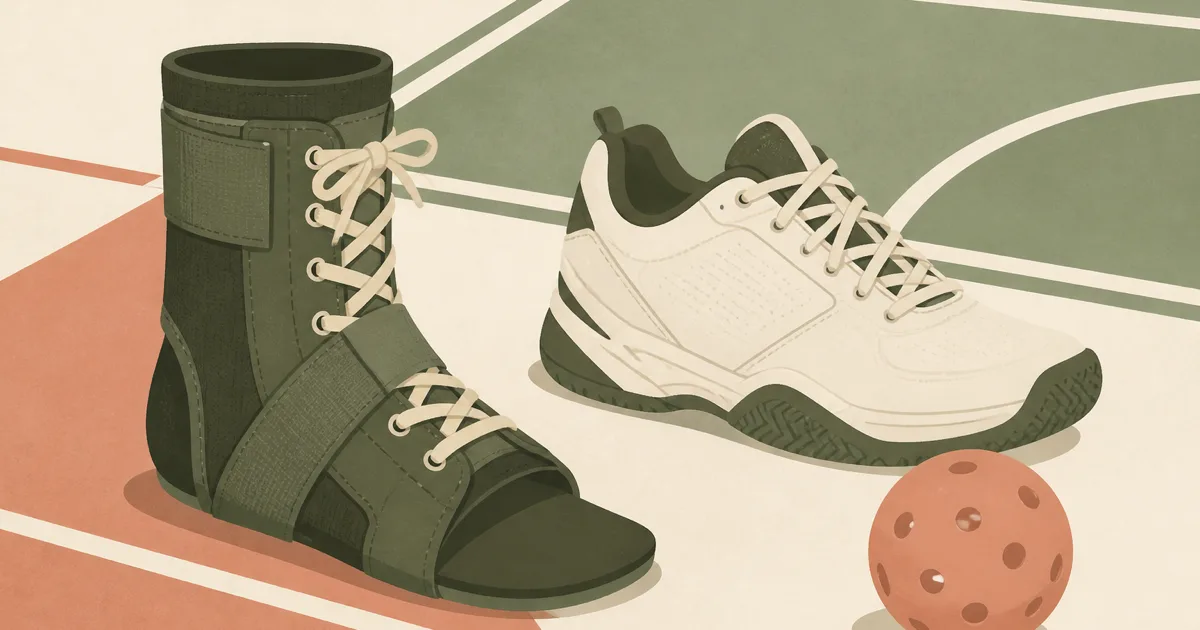
A lace-up brace with figure-8 or figure-6 straps tries to copy athletic taping. It holds the heel, resists inversion, and reminds you not to roll as far. It is support, not treatment.
What the figure-8 straps copy
A taped ankle uses a basket-weave wrap that locks the heel and limits sideways motion. A lace-up brace recreates that with angled straps. The straps are the part that does the work, which is why a thin sleeve is not the same product.
What a brace will not fix
It cannot heal ligaments, replace physical therapy, make running shoes safe for lateral cuts, or fix a shoe that is too big. If the ankle is swollen, bruised, or giving way, get it assessed. Then talk about bracing as a return-to-play tool.
Should you choose the ASO or the McDavid?
Choose the Med Spec ASO for the classic low-profile lace-up that trainers know. Choose the McDavid 195 when you want to retighten the outer straps mid-session without unlacing or removing the shoe.
Med Spec ASO Ankle Stabilizer: the lace-up primary pick
The Med Spec ASO Ankle Stabilizer is a lace-up boot with figure-8 straps. It is relatively low-profile, and the straps mimic a taped job without a fresh roll of tape every session. Buyer feedback on the listing we checked sits at 4.4 stars from 1,881 ratings, and the ASO is bilateral, so one unit fits either foot.
Sizing runs on ankle circumference, not shoe size. Check the chart and measure at the narrowest point above the ankle bone before you order.
Choose it if: You want a classic stabilizer that many court athletes already know.
Skip it if: You cannot lace a brace under your current shoe, or a clinician wants a rigid hinged brace instead.
Check the Med Spec ASO Ankle Stabilizer on Amazon.
McDavid Ankle Brace with Straps: the retightenable alternative
The McDavid Ankle Brace with Straps (the 195-style lace-up) adds figure-6 straps over a lace-up body. The useful trick is that you can often snug the outer straps without unlacing the whole brace or removing the shoe. It is listed as a level 3 support and comes bilateral.
Buyer feedback on this listing sits at 4.5 stars from 141 ratings. In a snug court shoe it will feel bulkier than a thin sleeve, so try it on at home before a match.
Choose it if: You want to retighten support between games without taking off your shoe.
Skip it if: You want the thinnest possible brace under a tight shoe.
Check the McDavid ankle brace on Amazon.
How much does a brace save over athletic tape?
A roll of athletic tape costs about $4 to $5 and covers roughly one ankle for one session. A reusable lace-up brace runs near $24, so it reaches payback in about five or six sessions. After that, every taped session you skip is money back.
The other saving is time and consistency. Taping a good ankle job on yourself is awkward, and a brace gives you the same tension every session. That repeatability is why trainers hand out lace-ups instead of tape for daily practice.
How do you size a lace-up ankle brace?
Size by ankle circumference, measured at the narrowest point just above the ankle bone. Shoe size is only a secondary guide. Between sizes, pick the larger one for comfort or the smaller one for firmer compression.
How do you fit a brace under a court shoe?
- Put on the sock you actually play in.
- Lace the brace so the heel sits down, not floating.
- Put the shoe on. If the heel lifts, the stack is too thick or the shoe is too big.
- Do a split step, a lateral shuffle, and a controlled lunge. Stop if anything goes numb.
- Recheck tightness after a warm-up, because swelling changes.
If the brace makes the shoe impossible, do not size up wildly and lose heel lock. Look at how pickleball shoes should fit and consider a dedicated court shoe with a little more volume.
Common mistakes with ankle braces
Buying a sleeve and calling it a brace is the usual miss. Compression is not the same as a laced stabilizer.
The other miss is wearing a brace over a worn running shoe. The brace cannot create a court outsole. Use pickleball or tennis court shoes, then add the brace.
Do not sleep in a tight lace-up unless a clinician said to. Skin breakdown and tingling are signs to loosen or stop.
How it fits a pickleball week
Wear the brace for the sessions that include hard cuts, not every casual dink. If you play four times a week, some players brace the first two sessions back from a sprain and then test one session without it, as long as a clinician agrees.
Take the brace off after play. Wash it on the schedule the listing allows. A soaked, salty lace-up smells, hardens, and rubs.
If the ankle feels worse the next morning, the brace did not give you a free pass. Cut volume and get advice rather than ordering a tighter model.
Open play is a bad place to debut a brand-new lace-up. Put it on at home, wear it around the kitchen, then take it to a practice session before league night.
Bottom line
A pickleball ankle brace is extra stability after an injury or for a known rolling ankle, not a shortcut around shoes and rehab. Start with the Med Spec ASO Ankle Stabilizer for a low-profile lace-up, or the McDavid Ankle Brace with Straps if you want outer straps you can retighten. Size by ankle circumference, confirm you can still plant in your court shoe, and see a clinician if the ankle is still giving way.
Compare court shoes in the shoes guides or start from the homepage.
Frequently Asked Questions
Does a pickleball ankle brace help?
It may reduce extra roll on cuts if it fits and you can still wear your court shoe. It does not heal a sprain or replace rehab. Sharp, swollen, or unstable ankles need a clinician, not another Amazon order.
Can I wear an ankle brace with pickleball shoes?
Usually yes if you size the brace and, if needed, loosen the laces over the brace. A brace that forces your heel out of the shoe is the wrong size.
Is a sleeve enough for pickleball?
A compression sleeve can feel reassuring. It does not replace a lace-up stabilizer after a sprain. Sleeves are for mild awareness and swelling, not for a rolling ankle.
Should I wear the brace on a healthy ankle?
Some players brace a previously injured side during open play. Do not brace a healthy ankle just because a partner does. Extra bulk can change your footwork.
How tight should a pickleball ankle brace be?
Snug enough that the heel does not lift, not so tight that toes tingle, go numb, or change color. You should still complete a split step without pain from the straps.
When should I skip play even with a brace?
Skip if you cannot hop, if the ankle gives way, if swelling is rising, or if pain is sharp on a normal plant. A brace is not permission to play through that.
Is this the same as buying supportive shoes?
No. Shoes are the first stability layer. A brace is extra hardware after an injury or for a known unstable ankle. Start with court shoes, then add a brace if a clinician or trainer agrees.