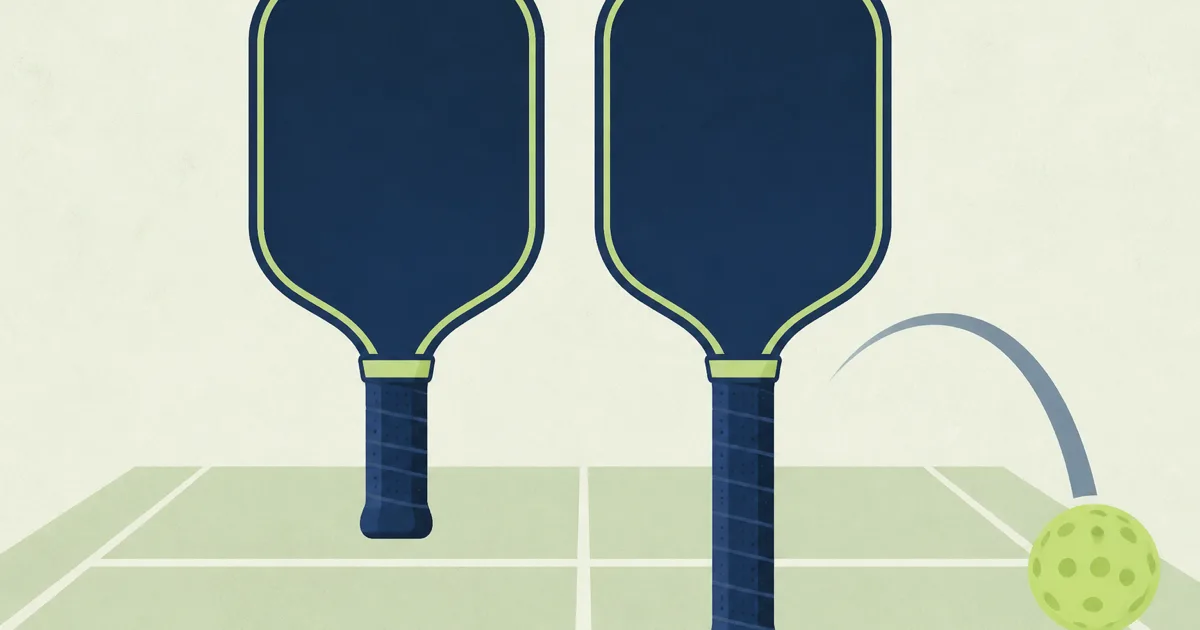
Pickleball Paddle Handle Length: Standard vs Long Grip
Paddles
Handle length is not grip size. A standard handle favors one-handed speed. A longer handle gives room for a two-handed backhand, and it competes with face size for the same legal budget.
Our picks
Handle length is easy to skip on a spec sheet because shops talk more about weight, thickness, and face shape. Then you get the paddle home, stack a two-handed backhand, and your top hand has nowhere to go.
Handle length is one spec, so the best pickleball paddles pillar shows how it varies by model, and the pickleball paddle guides act as the index.
Handle length is a different spec from face length, and it competes with it for the same legal budget. If your second hand crowds the throat, you need more grip room, not a longer advertisement. Specs change by variant, so confirm the current handle measurement before you order.
Start with the broader buying framework in how to choose a pickleball paddle. Face shape is a different decision. That lives in elongated vs widebody pickleball paddle. Circumference lives in pickleball paddle grip size.
Handle length vs grip size vs face length
Three numbers get mixed together, and only one of them is about how many hands you can fit.
- Handle length: usable grip from the edge of the throat to the butt cap, usually 5.0 to 5.5 inches.
- Grip circumference: how thick the handle feels in one hand, usually 4.0 to 4.25 inches.
- Overall paddle length: face plus handle, capped at 17 inches by USA Pickleball.
A long handle on a short face still gives two-hand room. A long face with a short handle gives reach without a second-hand parking spot. Read the handle number even when the paddle is marketed as elongated.
That distinction is why two paddles can both be called elongated and fit completely differently. The label describes the silhouette, not the grip.
How do you measure handle length?
Measure from the top of the butt cap to where the grip meets the throat, along the handle only. Do not measure the whole paddle, and do not trust the photo.
- Stand the paddle on the butt cap on a table.
- Lay a ruler along the grip, starting at the top of the cap.
- Stop where the grip ends and the throat or flared cone begins.
- Compare that number to the listing. Trust your measurement over the spec sheet.
Retail photos hide this. Two paddles can look identical in a bag and differ by a quarter inch, which is the difference between a comfortable two-hand grip and a jammed thumb.
If you are shopping in a store, hold a ready position and a two-handed backhand before you care about the paint. The handle either gives both hands a home or it does not.
What is the difference between a standard and a long handle?
About 0.2 to 0.5 inches, and it changes which shots feel natural. A standard handle keeps more of the legal length in the face. A long handle takes some of that length back for your second hand.
The gap sounds trivial. It is not. A quarter inch is roughly the width of your top index finger, which is exactly the part that ends up on the throat when the handle is too short.
Why does a quarter inch matter?
Because your top hand does not need an inch, it needs a place to sit. Once the top index finger clears the throat and lands on the grip, a two-handed backhand stops feeling cramped. Half an inch is usually enough to get there.
What does a long handle cost you?
Face area, and a little hand speed. The JOOLA Perseus Pro IV spends 5.5 inches on the grip and 16.5 on the whole paddle, so its face is narrower than a widebody of the same length. You gain a second hand and give up some off-center forgiveness.
Which measurement should you trust?
The one on the listing you are buying, not the one in a review of last year's model. Variants change within a line, and a shape name like elongated or Max describes the silhouette rather than the grip.
Can a long handle cost you face size?
Yes, and the rulebook is where it shows up. USA Pickleball caps overall length at 17 inches and length plus width at 24 inches, so every inch of handle is an inch the face cannot use.
The JOOLA Perseus Pro IV makes this visible. It is 16.5 inches long and 7.5 inches wide, which is exactly 24 inches combined. There is no room left in either direction. Spend more on the handle and the face gets narrower, or the paddle stops being legal.
That does not make it a bad paddle. It makes the trade visible. A widebody with a long handle ends up with a shorter face, which changes where the sweet spot sits relative to your hand.
Rule 3.D.3 also sets no weight limit, so a long handle is a feel decision rather than a legality decision. Only the dimensions are capped.
Do you lose reach with a standard handle?
A little, and it shows up most on serves and overheads. A short handle puts your hand closer to the face, which shortens the lever. For a kitchen player who wins points on resets, that is a fair trade. For a server who wants free depth, it is not.
Standard handles (about 5.0 to 5.3 inches)
A standard handle keeps more of the paddle's legal length in the face. That often means a slightly larger hitting area and a quicker wrist for blocks, rolls, and counters.
Choose this range if you:
- Hit a one-handed backhand
- Live at the kitchen and want fast hands
- Do not want extra mass hanging below the throat
- Are coming from a rec paddle that already felt fine
The Vatic Pro Prism Carbon Fiber 16mm is the standard-handle pick here. It reads 4.6 stars from 1,701 ratings at $99.99 today, with a foam-injected 16mm build, a carbon face, and a paddle cover included.
Published comparisons put the Prism Flash handle near 5.3 inches. Confirm the exact SKU, because Vatic also sells longer-handle versions of related models, and the shape name does not settle the number.
Skip a standard handle if you already know you need two full hands on the grip. Choking up on a short handle works for a few shots. It gets old over a two-hour session.
Check the Vatic Pro Prism on Amazon.
Long handles (about 5.5 inches)
A 5.5-inch handle is the usual ask from tennis converts who keep a two-handed backhand. You get a real home for the top hand, a slightly longer lever, and often more reach when the face is elongated too.
Choose this range if you:
- Hit two-handed backhands or two-handed resets
- Want extra room for a continental-to-eastern change without crowding
- Like a little more plow-through on drives
- Can accept a slower hand if the paddle also plays head-heavy
The JOOLA Ben Johns Perseus Pro IV 16mm is the longer-handle pick. The listing confirms a 5.5-inch grip, a 16.5-inch length, a 7.5-inch width, and 7.9 ounces, and it carries both UPA-A and USAP certification.
That combination gives a two-handed player a place for the top hand and a little extra leverage on serves. It also means the face is narrower than a widebody, so off-center contact is less forgiving than on the Selkirk SLK Halo.
A longer handle does not automatically mean a better paddle. If you never use a second hand, you paid for unused real estate and may have given up face width.
Check the JOOLA Perseus Pro IV on Amazon.
Quick comparison
The price gap is $50, which is the entire cost of finding out you did not need the extra handle. Measure a paddle you already like before you pay it.
Put the butt cap in your palm and see where your index finger sits relative to the throat. If your finger is already on the edge guard, a longer handle will feel like a different paddle, not a small tweak.
Can you add handle length later?
Mostly no. An overgrip adds circumference, not length, and wrapping more tape only makes the handle thicker in the same place.
Handle extensions exist and some players use them, but they change the balance point and they may push the paddle past the 17-inch length cap. USA Pickleball allows edge tape and weighted tape as player alterations, not structural changes to the handle.
The cleaner path is to buy the length you need. It is cheaper than experimenting with a paddle you already own, and it keeps the balance the maker designed.
Common mistakes
The usual mistake is buying an elongated face because a friend said it has a "longer handle," then discovering the handle is still 5.25 inches. Ask for the handle spec in inches.
The second mistake is stacking overgrips to fake length. Extra wraps make the handle thicker. They do not create room for a second hand. If the handle is short, change paddles.
The third mistake is ignoring swing weight. A 5.5-inch handle on a head-heavy power paddle can feel great on a serve and heavy on a four-ball kitchen firefight. Demo if you can, and use the return window if you cannot.
The fourth is assuming the shape name is a spec. Vatic sells a long-handle variant at 5.6 inches, Selkirk sells the same core in Max and elongated bodies, and JOOLA's Pro line spans several shapes. Read the number on the listing you are actually buying.
For tennis players still sorting grips, read best pickleball paddle for tennis players and how to hold a pickleball paddle after you lock handle length.
Bottom line
Handle length is a hand-count decision with a legal ceiling. If you play one-handed, a standard handle such as the Vatic Pro Prism Carbon Fiber 16mm at $99.99 keeps the paddle quick and the face big. If you need room for two hands, the JOOLA Perseus Pro IV at $149.95 lists a 5.5-inch grip and delivers it.
Confirm the listed handle length on the exact variant before you check out, and remember that every extra half inch of handle comes out of the face. The paddle you want is the one where your top hand lands on the grip, not on the throat.
Frequently Asked Questions
What is a typical pickleball paddle handle length?
Most recreational paddles land near 5.0 to 5.3 inches of handle. Longer models often list 5.5 inches, and a few long-handle variants reach 5.6. Always check the current spec sheet, because shape names do not guarantee handle length.
Is pickleball paddle handle length the same as grip size?
No. Handle length is how much room you have for your hands along the grip. Grip size is circumference, usually 4.0 to 4.25 inches. You can have a long handle that is still too thick or too thin, which is why the two numbers are listed separately.
How long should a handle be for a two-handed backhand?
About 5.5 inches, so the top hand is not hanging off the butt cap. A 5.0 to 5.3 inch handle can work if you choke up, but it usually feels cramped after a few games. The practical test is whether your top index finger lands on the throat.
Does a longer handle add power?
It can add leverage on drives and serves, and it often travels with an elongated face. The cost is a slower hand at the kitchen if the whole paddle also plays head-heavy. Measure swing weight, not just handle length.
Can I add length with an overgrip or extension?
An overgrip adds circumference, not useful length. Handle extensions exist, but they change balance and may not stay legal because USA Pickleball caps total paddle length at 17 inches. It is usually cleaner to buy a paddle that already lists the length you need.
What is the legal limit on paddle length?
USA Pickleball Rule 3.D.2 caps overall length at 17 inches and caps length plus width at 24 inches, including the edge guard and butt cap. There is no weight or thickness limit. A long handle and a long face draw from the same budget.
Do elongated paddles always have long handles?
No. Face length and handle length are separate numbers. Some elongated paddles keep a 5.0 inch handle and spend the extra length on the face. Our shape guide covers that decision.
Should beginners buy a long handle?
Only if you already hit a two-handed backhand from tennis or you know you want that extra room. Most new players do better with a standard handle and a forgiving face.