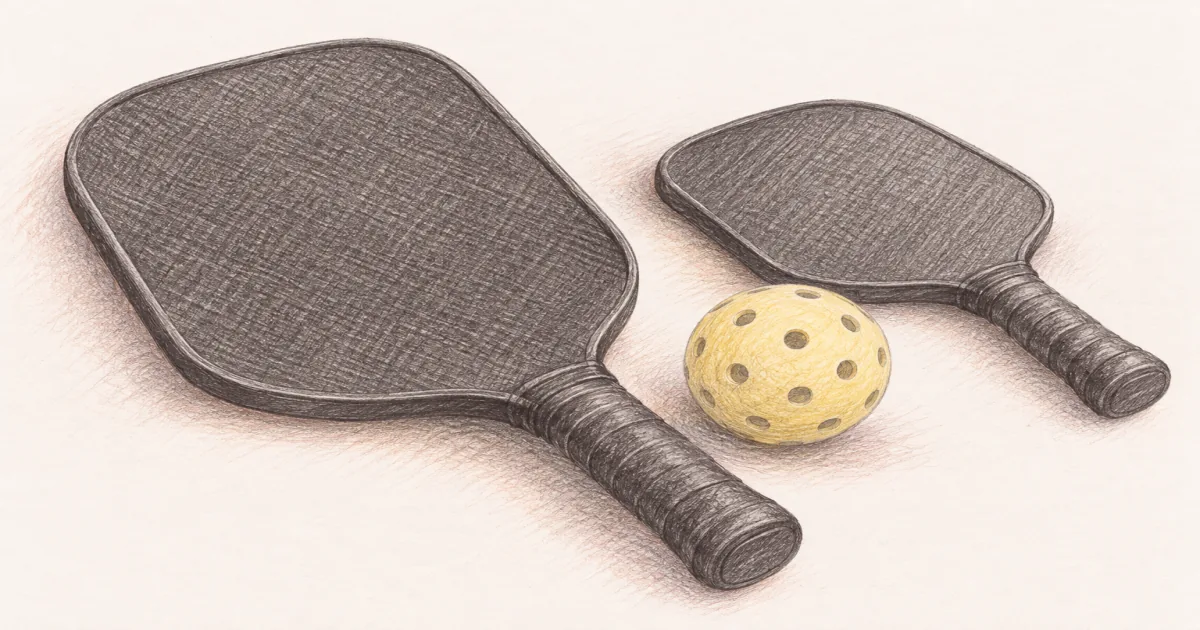
Best Graphite Pickleball Paddle (2026): Connected Feel That Still Plays
Paddles
Graphite faces still earn their spot when control and quiet feedback beat raw-carbon pop. Start with ONIX Graphite MOD Z5 for the classic widebody, then size up to HEAD Radical XL for reach or Selkirk SLK Latitude for value.
Our picks
If you are shopping the best graphite pickleball paddle, you already know that raw carbon dominates 2026 marketing. Graphite did not disappear. It is still the smoother, quieter face that lets clean contact stay readable. Buy graphite when you want feedback you can trust on dinks and resets. Skip graphite when you want maximum spin grit and a hotter launch.
For a longer primer on how a graphite face plays versus raw carbon, see graphite pickleball paddle. For a face-versus-face split with two Amazon paddles side by side, see graphite vs carbon fiber pickleball paddle. Browse the wider map in our paddles category or the best pickleball paddles pillar.
What "best graphite" really means in 2026
Graphite is a face material, not a magic tier. A graphite sheet sits over a core that can be Nomex (older, firmer, louder) or polymer honeycomb (newer, softer, quieter). The face is what you feel on contact and on mishits. The core is what decides how the paddle treats soft balls and how much dwell you get.
A good graphite shortlist matches face texture to the kind of contact you actually have. Smoother sheets reward players who already keep soft balls down. Textured graphite (SpinFlex, Extreme Spin) closes some of the spin gap with raw carbon without changing the underlying feel.
Thickness still matters more than the marketing noun. A 16mm polymer graphite paddle plays softer than an 11mm Nomex graphite paddle, and a thin elongated graphite face plays nothing like a widebody 13mm polymer one. Confirm the core and the shape before you read the listing copy.
Quick comparison
Top pick: Onix Graphite MOD Z5
The Onix Graphite MOD Z5 is the safe answer to best graphite pickleball paddle for most control-first players. Widebody shape, graphite face, Nomex honeycomb core, midweight 7.5 to 8.2 oz band, and a tennis-style handle that crossover players already know. The 2025 Mod variants keep the classic widebody sweet spot that made the Z5 the rec-court default.
What you get from the MOD Z5 is honest feedback. Off-center hits lose less of the point than a thin carbon power face. Dinks stay readable. Drives leave the face when your timing is clean. What you give up is the cushioned dwell of a 16mm polymer paddle and the quieter launch of a textured raw-carbon surface.
The honest tradeoff is the Nomex click. If your arm or your partner's arm is sensitive to vibration, the Z5 will feel more direct than a polymer graphite paddle. That directness is the point for control players. It is not the right answer for everyone.
Who it is for: Rec and intermediate players who want a widebody graphite paddle with a known feel. Good for tennis converts who already know the Z5 grip shape.
Pros
- Widebody sweet spot forgives off-center blocks and counters
- Graphite face with extra grit for predictable kitchen spin
- Midweight balance for longer doubles sessions
- USA Pickleball approval text on most listings
Cons
- Nomex core runs loud and direct compared to a thick polymer paddle
- 11mm thickness gives less dwell than a modern 16mm carbon build
- Sound and vibration can bother players with arm sensitivity
Best elongated reach: HEAD Radical XL
The HEAD Radical XL is the answer when you want graphite on an elongated face. Polypropylene honeycomb core with OTC construction, graphite hitting surface with Extreme Spin texture, 7.6 oz midweight, 13mm thickness, and a 17-inch elongated shape that adds reach for stretch volleys and two-handed backhands.
Why it earns its slot here is the combination of graphite feel and a polymer core. The 13mm polymer dampens vibration better than the older thin Nomex graphite builds, and the Extreme Spin texture closes some of the spin gap with raw carbon. You do not get a widebody sweet spot. You get reach and a face that still rewards clean contact.
The honest tradeoff is the elongated sweet spot. It punishes off-center hits sooner than the MOD Z5. If your footwork is not yet covering the face, expect more mishits than a widebody graphite paddle would give you. Weight usually lands near 7.6 oz. The Radical XL is lighter than its 8.1 oz Red sibling, so players who want more plow-through should look at the heavier version or another model.
Who it is for: Tennis converts who want reach and a graphite face, intermediate players adding elongated reach to their game, doubles players who want more two-handed backhand room.
Pros
- Elongated shape adds reach on stretch volleys and serves
- Polypropylene honeycomb core softens vibration versus thin Nomex graphite
- Extreme Spin texture gives the graphite face real brush bite
- 7.6 oz weight lands in a friendly midweight range for kitchen hands
Cons
- Elongated sweet spot is less forgiving than a true widebody
- Smaller swing-weight window than the heavier Red sibling
- Less open-play brand recognition than JOOLA or Selkirk flagship paddles
Best graphite value: Selkirk SLK Latitude 13mm
The Selkirk SLK Latitude 13mm is the graphite paddle for players who want texture and a polymer core without paying LUXX pricing. Graphi-Flex graphite face, SpinFlex+ surface, 13mm SX4 polymer honeycomb core, 7.6 to 8.0 oz weight range, and a Max widebody shape that opens up the sweet spot.
Why it earns the value slot is the SpinFlex+ surface. Plain graphite sheets tend to start with less face grab than raw carbon. SpinFlex+ gives the graphite face a textured layer that holds the ball longer on contact, which helps on serves, rolls, and slice returns without forcing a raw-carbon feel. The SX4 polymer core at 13mm softens mishits more than a thin Nomex graphite build, which matters for players still cleaning up contact.
The honest tradeoff is brand ubiquity at open play. Less of this paddle shows up on random court fences than JOOLA or Selkirk's flagship LUXX lines. That should not stop you if the specs match your hand and your budget. The Max widebody shape runs larger than a true midbody. Players who already know they want an elongated shape should keep shopping.
Who it is for: Intermediate and improving players who want a textured graphite face and a polymer core. Buyers comparing budget graphite paddles across Selkirk, HEAD, and ONIX.
Pros
- Graphite face with SpinFlex+ texture for clearer spin than a smooth sheet
- 13mm SX4 polymer core softens mishits versus thin graphite builds
- Lightweight 7.6 to 8.0 oz range keeps kitchen hands quick
- Widebody Max shape expands the usable face
Cons
- Less brand recognition than JOOLA or Selkirk LUXX flagship paddles
- Widebody Max shape runs larger than a midbody for smaller hands
- Newer product line has shorter review depth than the older ONIX Z5
How to pick between them in two minutes
Write down the miss you want to fix first. Long soft balls and quiet hands → start with the MOD Z5. Reach and elongated control → start with the HEAD Radical XL. Spin texture on a budget → start with the Selkirk SLK Latitude.
Then confirm grip circumference and weight band on the product page. A graphite paddle cannot fix a 4.5-inch handle that fights your hand. A 7.6 oz paddle will feel whippy if you came from a 8.2 oz Z5. The specs that decide fit are rarely the spec the headline photo leads with.
If you already know you want a control paddle but graphite is not locked, read best pickleball paddle for control for a broader control shortlist. If you are still sorting face materials in general, the graphite vs carbon fiber compare will save you an Amazon trip.
Care that keeps a graphite face working
Wipe chalk and ball residue after dusty sessions. Do not scrape the face on fences or benches. Store the paddle in a cover so bag zippers do not sand the finish. A graphite face is smoother than raw carbon, which means scratches and grime show up sooner. Keep a small paddle eraser around for the in-between polish. More on face care lives in how to clean a pickleball paddle.
If you came from a raw-carbon paddle and the graphite face feels "dead" at first, that is the texture gap, not a defect. Spin returns once you adjust your brushing technique and after the face picks up a little court grit. Most players stop noticing the difference within a few open-play sessions.
Who should skip these picks
Skip the MOD Z5 if your arm is sensitive to vibration or if you already know you want a quiet 16mm polymer-core paddle. The Z5 is honest, not cushy.
Skip the HEAD Radical XL if your footwork still struggles with the kitchen. The elongated sweet spot punishes mishits. A widebody graphite paddle is a kinder teacher until footwork catches up.
Skip the Selkirk SLK Latitude if brand recognition matters more than spec. The flagship Selkirk LUXX and JOOLA Ben Johns lines cost more and they will be on every court. If open-play social proof is part of why you are buying, expect to push the budget up.
Bottom line
The best graphite pickleball paddle is the one that matches how you already miss. Start with the Onix Graphite MOD Z5 for a connected widebody control feel. Take the HEAD Radical XL when elongated reach is the priority. Pick the Selkirk SLK Latitude 13mm when you want graphite texture and a polymer core at a friendlier price. Confirm weight, grip, and approval text on the Amazon listing before you click buy. Stock and colorways change, and specs are the decision, not the headline.
Frequently Asked Questions
What is the best graphite pickleball paddle for most players?
The Onix Graphite MOD Z5 is the safest pick when you want a widebody graphite face with a connected Nomex feel. Choose the HEAD Radical XL when reach and elongated control matter more, or the Selkirk SLK Latitude 13mm when a textured graphite face and a polymer core fit a quieter kitchen game.
Is graphite better than carbon fiber on a pickleball paddle?
Not better in absolute terms. Graphite usually means a smoother, more connected face that rewards clean contact. Raw carbon usually adds more starting texture and a crisper leave. Pick graphite when soft game is your priority and your contact is already consistent. Pick carbon when you want more free spin grit. Side-by-side shopping: graphite vs carbon fiber pickleball paddle.
Do graphite paddles have less spin than raw carbon?
Usually yes, on day one. A smooth graphite sheet starts with less face grab than a raw T700 carbon weave. Spin still comes from technique, ball condition, and grip. Many graphite paddles add a textured surface (like the SLK Latitude's SpinFlex finish or the HEAD Radical XL's Extreme Spin texture) that closes the gap.
Are graphite paddles good for beginners?
Yes when the paddle is widebody and midweight. A graphite paddle with a 16mm polymer core is a common beginner answer. Skip thin Nomex graphite until you trust your contact. For the full beginner path, see best pickleball paddle for beginners.
Is the Onix Z5 still the best graphite paddle in 2026?
The Onix Graphite MOD Z5 is still the default control-first graphite paddle, with a widebody sweet spot and a graphite face that most rec players already swing at open play. It is the safer pick when you want the older connected feel. Move to the HEAD Radical XL for reach, or to the Selkirk SLK Latitude for a polymer-core graphite option with more spin texture.
Graphite vs fiberglass pickleball paddle?
Fiberglass usually feels springier and cheaper at the entry price. Graphite usually feels crisper and quieter. Fiberglass is a fair first paddle. Graphite is the upgrade path once contact is consistent. The full split is in carbon fiber vs fiberglass.
What core thickness works best with a graphite face?
A 16mm polymer core softens mishits and keeps resets quieter. A thinner Nomex core (the original Z5 design) feels firmer and louder but gives clearer contact feedback. Match thickness to how often you mishit and how much soft game you play. More thickness math lives in pickleball paddle thickness explained and the best 16mm pickleball paddle shortlist.
Can I use a graphite paddle in sanctioned tournaments?
Most name-brand graphite paddles list USA Pickleball approval on the product page. Approval text changes. Check the current USAP approved paddle list and the Amazon listing before a rated event.