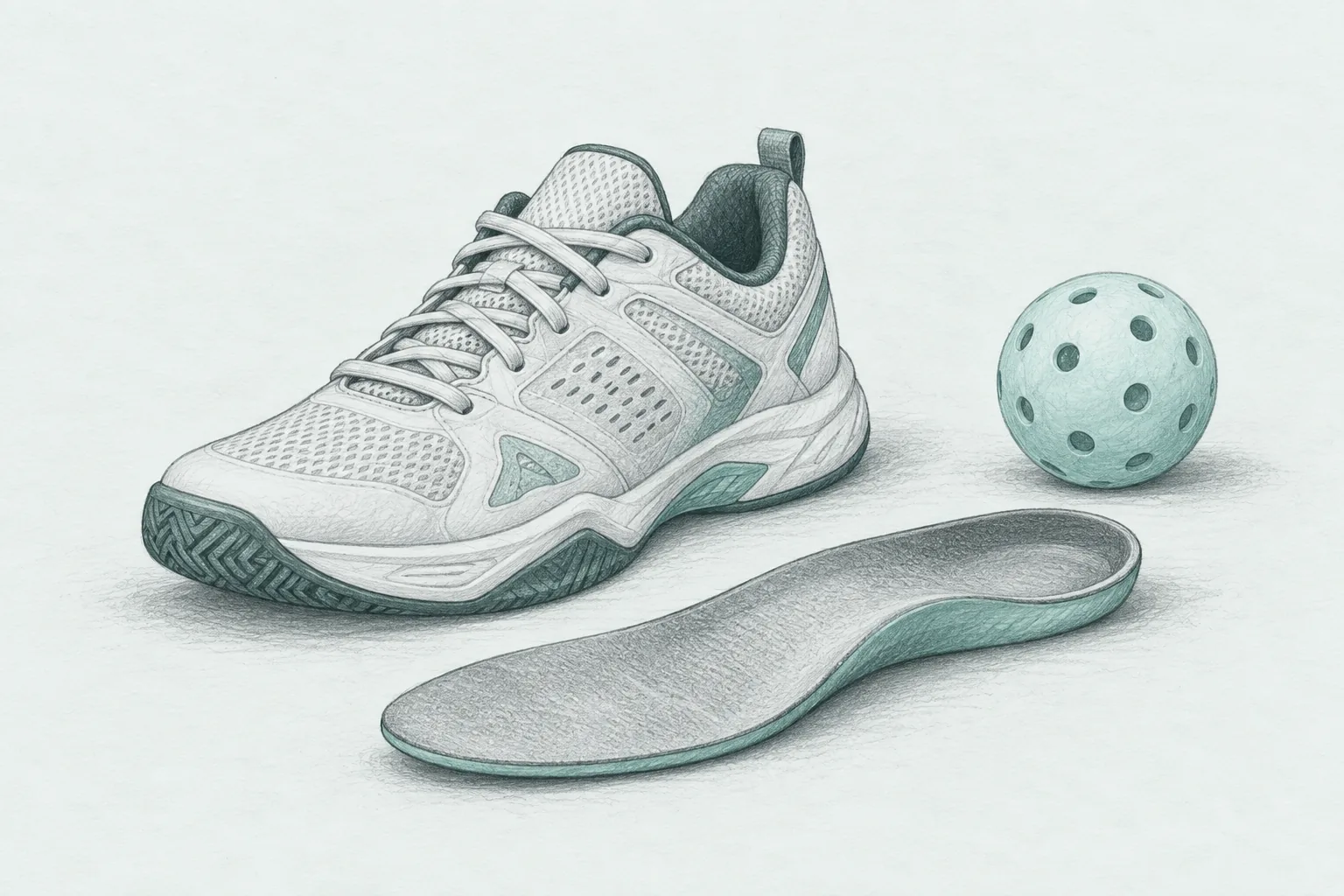
Best Pickleball Insoles (2026): Arch Support That Ends Foot Pain
Shoes
A good court shoe still ships with a flat, flimsy insert. These three pickleball insoles add arch support, heel lock, and grip so your feet survive a long session.
Our picks
A court shoe is only as good as the footbed under your foot. Most pickleball shoes ship with a flat, paper-thin insert that does nothing for your arch and lets your foot slide on hard cuts. That is the gap an insole fills. It will not turn a bad shoe into a good one, but it will make a decent shoe feel planted for a full session.
This guide covers three pickleball insoles for three jobs. One is built for the sport, one is a budget first step, and one is for players who want cushioning above all. If you are still choosing the shoe itself, start with our best pickleball shoes guide, then check the fit rules in how should pickleball shoes fit. Everything sits under the shoes category.
What an insole actually fixes
Pickleball asks a lot of the foot in a small space. You plant for an overhead, slide to cover the kitchen line, and stop hard on concrete, all within a few seconds. A flat stock insert does not hold the arch, so the foot rolls inward and the load lands on the wrong spot.
A good insole adds three things. Arch support keeps the foot from collapsing under load. A deeper heel cup holds the heel so it does not wander on a cut. A grippy or textured top layer stops the foot sliding inside the shoe, which is the quiet cause of a lot of hot spots and blisters.
What an insole does not do is replace lateral support in the shoe. If the shoe itself twists or the outsole is bald, an insert will not save it. Fix the shoe first, then tune the footbed.
Quick comparison
Best overall: CURREX PickleballPRO
The CURREX PickleballPRO is the best pickleball insole for players who want a footbed designed for the sport rather than adapted from running. It comes in low, medium, and high arch profiles, so you match the insole to your foot instead of forcing one shape on everyone.
The top layer is built to grip, which cuts the small slide you feel inside a shoe on a lateral stop. A deep, decoupled heel cup holds the back of the foot, and the dual-layer cushioning adds rebound without turning the shoe into a marshmallow. Reviewers who tested it describe the fit as feeling close to custom within the first hour of wear.
Pick your arch height with the wet-foot test before you order. Medium is the safe default if you are not sure. The insole is thin under the forefoot on purpose, so your court shoe keeps its low profile. It is also hand wash only, which is worth knowing before you toss it in the machine.
Best for: Players who want real arch support and less foot slide inside an existing court shoe.
Skip if: You want a thick, plush cushion under the toes.
Check the CURREX PickleballPRO on Amazon.
Best value: Dr. Scholl's Sport Insoles
The Dr. Scholl's Sport Insoles are the best pickleball insole for a first upgrade on a budget. They add moderate arch support and flexible side-to-side stability at a price low enough that you can buy a pair for each court shoe you own.
The support is moderate, which is why they suit a wide range of feet. They help hold a neutral position through quick direction changes, and testers report less pressure on the ball of the foot and less lower-back ache after long sessions. For a casual player who has never used an insole, this is the least fussy way to try one.
They are not a running-specific insole, so do not expect deep cushioning for high mileage. In a very slim shoe they can feel a touch bulky. For most court players, though, they are a sensible first step before spending more.
Best for: Casual players who want better arch support without spending much.
Skip if: You want maximum cushioning or a firm, rigid arch.
Check the Dr. Scholl's Sport Insoles on Amazon.
Best cushioning: SOFSOLE ATHLETE
The SOFSOLE ATHLETE is the best pickleball insole when cushioning matters more than arch height. Gel pads in the heel and forefoot absorb impact, and a neutral arch makes it easy to fit without a wet-foot test.
The all-foam build prioritizes shock absorption over rigid correction, which is the right call for players whose feet are otherwise fine but who feel beat up after outdoor play. A moisture-wicking top fabric keeps the foot drier, and the neutral profile avoids the golf-ball-under-the-foot feel that some firm insoles create.
Plan for the extra volume. If your court shoe already fits close, remove the factory insert and try the SOFSOLE before a match, not on game day. The top layer can wear around the big toe over a long season, so retire the pair when the cushioning flattens.
Best for: Outdoor players who want more cushion under a hard-court shoe.
Skip if: Your shoes already fit tight, or you need firm, rigid arch correction.
Check the SOFSOLE ATHLETE on Amazon.
How to choose the right arch height
Start with your own arch, not the price. The wet-foot test is the simplest way: wet the sole of your foot, step on a paper bag, and look at the print. A wide, flat print points to a low arch. A narrow print with a clear curve points to a high arch. Anything in between is medium.
A low or medium profile suits flatter feet, and a high, firmer arch usually wants the high profile so the insole does not collapse under load. If you are between profiles, medium is the safer choice.
Then match the insole to the job. A thin, grippy insole like the CURREX keeps a court shoe low and planted. A cushioned insole like the SOFSOLE softens hard concrete but adds volume. A budget pair like the Dr. Scholl's splits the difference. Pick the one that matches what your feet actually complain about.
When to replace an insole
Replace it when the arch goes flat, the top layer wears through, or the same foot pain comes back after a stretch of feeling fine. A cushioning insole usually loses its rebound first. A firmer insole can last longer but still packs down over a season.
You can stretch the life by rotating two pairs if you play most days. Let them dry out of the shoe after a sweaty session instead of leaving them sealed inside. Wash the ones that are washable by hand, and let them air dry fully before they go back in.
Do not wait for a hole. Once the support is gone, the insole is just extra fabric in your shoe.
Who should skip an insole
Skip an insole if your court shoes already feel planted and your feet are happy. A good shoe with a supportive footbed does not need help.
Skip a firm, corrective insole if your pain is sharp or one-sided. That is a job for a clinician, not a product page. An over-the-counter insole is for comfort and mild support, not a diagnosis.
Skip a thick cushioning insole if your shoes already fit snug. The added volume will make a tight shoe worse, and a loose heel on a cut is a real risk. Start with a thin profile instead.
If your shoes are the weak point, read how should pickleball shoes fit and our guides to plantar fasciitis and flat feet before you buy inserts.
Bottom line
The best pickleball insole is the one that holds your arch and keeps your foot from sliding, so you stop thinking about your feet mid-rally. Start with the CURREX PickleballPRO for a purpose-built court footbed with the right arch profile. Choose the Dr. Scholl's Sport Insoles for a cheap first upgrade, or the SOFSOLE ATHLETE when hard outdoor concrete is the enemy. Match the insole to your arch, and your existing shoes will feel better by the first game.
Frequently Asked Questions
What are the best pickleball insoles?
The CURREX PickleballPRO is the best pickleball insole for most players who want a footbed built for the sport. It has a grippy top layer, a deep heel cup, and three arch heights. If you want a low-cost first upgrade, the Dr. Scholl's Sport Insoles add moderate arch support for a fraction of the price.
Do I really need insoles for pickleball?
Only if the stock insert is letting your foot slide or your arch ache after a session. Most court shoes ship with a thin, flat insert that offers little arch support. If your feet, knees, or lower back complain after normal play, an insole is a cheap thing to try before you buy new shoes.
What arch height should I choose?
Match the insole to your own arch, not your skill level. Flatter feet usually do best in a low or medium profile, and a higher, firmer arch usually wants the high profile. If you are unsure, do the wet-foot test: wet your foot, step on a paper bag, and look at the print.
Are pickleball insoles different from running insoles?
Mostly no. The arch support and heel cup that help a runner help a pickleball player too. The one difference is that a court insole usually has a thinner forefoot so the shoe stays low-profile on cuts and pivots. A running insole with a thick forefoot can make a court shoe feel unstable.
Can insoles fix plantar fasciitis or heel pain?
They can reduce the load that causes the pain, but they are not a cure. A supportive insole plus a shoe with a proper heel counter helps most people. If the pain is sharp or lasts for weeks, see a clinician rather than buying a third pair of inserts.
Will insoles make my shoes feel too tight?
They can. Any insole adds volume, so a snug court shoe will feel snugger. Remove the factory insert before you drop in a new one, and consider a thinner profile if the shoe already fits close. Some players go up a half size when they add a thicker cushioning insole.
How often should I replace pickleball insoles?
Replace them when the arch flattens, the top layer wears through, or your feet start hurting again after they had felt fine. Heavy players often get a few months from a cushioning pair. A firmer, better-built pair can last a full season of regular play.
Do insoles replace the need for court shoes?
No. An insole helps the footbed, but it cannot fix a shoe with no lateral support. If your outsole is smooth or the shoe rolls on cuts, fix the shoe first and add an insole second. See our best pickleball shoes guide for the shoe itself.