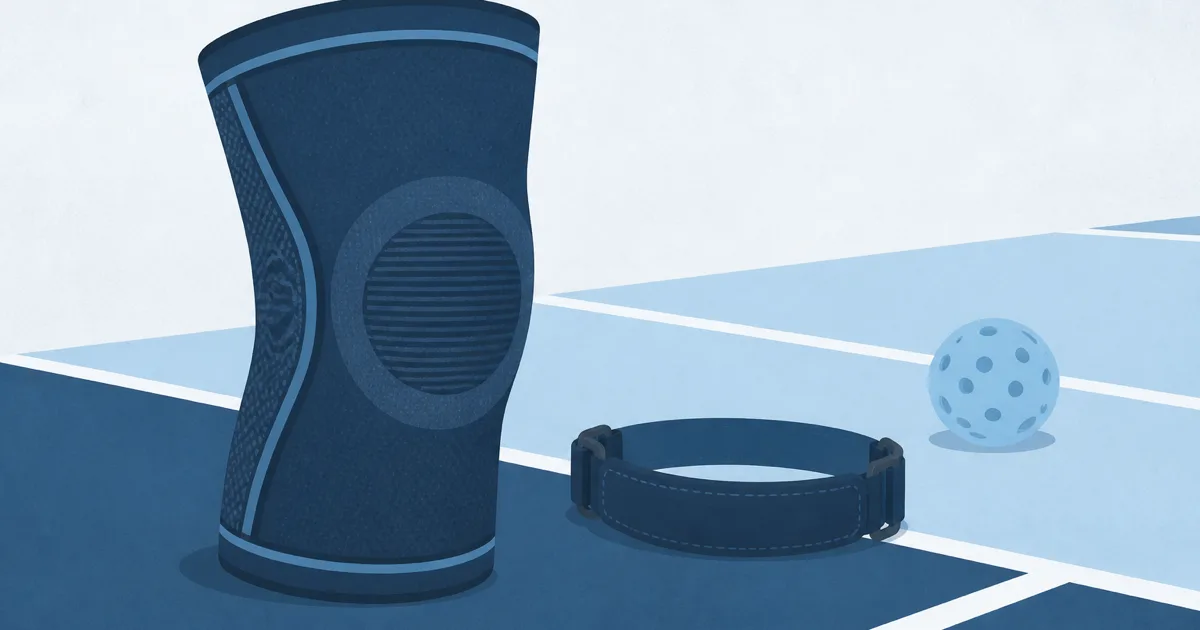
Best Pickleball Knee Brace: Sleeve vs Strap for Court Play
Accessories
A knee sleeve adds broader support. A patella strap targets the tendon below the kneecap. Here is how to size either one properly, and when shoes matter more than a brace.
Our picks
Knees take a beating on pickleball courts because the sport is full of short stops, split steps, and low ready positions. A brace can add compression or targeted pressure. It cannot rebuild cartilage or undo a jump from a standing start with a locked knee.
Support gear is only one part of the kit, so browse the pickleball accessories guide collection for the rest.
This guide compares two knee supports sold in the US, using their size charts and what buyers say after a few weeks of play. No brace replaces an assessment. If pain is sharp, the knee locks, or it gives way, skip the shopping cart and get it checked.
Footwear still comes first. Unstable shoes make any brace look useless. Start with best pickleball shoes for knee pain if your current pair is a running shoe.
Sleeve vs strap: which do you need?
A sleeve covers the joint. A strap presses one spot. If you cannot point to the sore area with one finger, start with the sleeve.
Sleeve. Covers the joint. Adds warmth, compression, a patella opening or pad, and sometimes spring stays on the sides. Better when the whole knee feels tired or you want a reminder to keep it stacked.
Strap. A narrow band below the kneecap. Presses on the patellar tendon. Better when the pain is a specific hot spot after jumping, lunging, or going downstairs.
If you can point to the sore spot and it sits just below the kneecap, start with the strap. That is the classic jumper's knee location, and a strap is built for it.
When is a sleeve the right call?
When the whole knee feels tired or unstable rather than sharp in one place. A sleeve adds warmth and mild side support, and it covers the joint instead of one spot, which suits players who feel the knee after a session rather than during a single lunge.
When is a strap the right call?
When the pain has an address. A strap presses the patellar tendon just below the kneecap, so it suits the ache that shows up on stairs, on the first jump, or after a long sit between games.
What about a hinged brace?
That is a different product with a different job, and it is usually prescribed after a ligament injury. Neither pick here is hinged, and buying one without guidance can change how you move in ways that are not helpful.
What size knee brace do you need?
Measure, then read the chart. Sizing is the single biggest reason a brace ends up in a drawer, and both picks handle it differently.
The NEENCA is sold in seven sizes, and the chart uses thigh circumference, calf circumference, and brace height rather than body weight or height.
That is a 17.6 inch spread from the smallest thigh band to the largest, which is why "get a medium" is not advice. Measure the leg you actually play on, at the thigh about four inches above the kneecap and at the widest part of the calf.
The CAMBIVO goes the other way: one size, adjusted with hook-and-loop. That is easier to buy and harder to get wrong, but it also means the fit is set by the strap tension rather than the cut.
What if you are between two sizes?
Go with the band that contains your measurement at both the thigh and the calf, and treat the tighter number as decisive. A sleeve that fits the thigh but gaps at the calf will slide. If the two measurements land in different bands, the larger size is usually the safer buy for a sleeve, because a slightly loose brace can be adjusted while a tight one cannot.
Sleeve pick: NEENCA Professional Knee Brace
The NEENCA Professional Knee Brace reads 4.4 stars from 1,737 ratings at $25.99. It is built for people who want more than a thin drugstore sleeve without jumping to a hinged brace.
That middle lane is where most recreational players belong. A hinged brace is a medical device with a specific job, and it is usually prescribed. A sleeve adds warmth and a little side support without locking the joint.
Choose NEENCA if you want broader support for two-hour doubles. Skip it if you only have a small tendon hot spot and hate heat around the joint, because a full sleeve covers more surface than a strap.
Check the NEENCA knee brace on Amazon.
Strap pick: CAMBIVO 2 Pack Patella Tendon Knee Straps
The CAMBIVO 2 Pack Patella Tendon Knee Straps reads 4.3 stars from 15,556 ratings at $9.99. It is a patella tendon strap with a tubular buttress and hook-and-loop closure, sold as a two-pack so you have a spare or can share with a partner.
The number of ratings is worth weighing. More than 15,000 is roughly nine times what the sleeve has, which tells you a product works for a lot of people rather than a few enthusiasts.
Place it below the kneecap, not across the middle of the kneecap, unless the product card says otherwise. Choose the strap if you want something you can put on in the parking lot and forget. Skip it if the whole joint feels unstable, because a strap will not hold a wobbly knee.
Check the CAMBIVO 2 Pack Patella Tendon Knee Straps on Amazon.
Quick comparison
The sleeve costs about 2.6 times the strap pack, and the gap is $16. That is small enough that the decision should come from your symptom rather than the price.
You can own both. Wear the strap for lighter days and the sleeve when the court is extra hard or the session is long. Do not stack them tight enough to trap swelling.
How do you check the fit on court?
Put the brace on before you warm up, run three movements, then recheck. Fit problems show up in motion, not in the mirror.
- Measure, then order from the chart rather than your usual size.
- Put the brace on before the shoe if the sleeve goes over the calf.
- Do a split step, a lateral shuffle, and a controlled lunge.
- Look for sliding, pinching behind the knee, or tingling.
- Recheck after the first game, because sweat changes everything.
If the sleeve leaves a deep ring and your foot feels odd, it is too tight. If you keep tugging it up, it is too loose. Both are sizing problems, and both are fixable before you decide the product is bad.
Common mistakes
Using a brace so you can skip rest is the dangerous one. Soreness that fades after a warm-up is different from pain that climbs during a game.
The other mistake is ignoring shoes. A soft runner plus a $40 sleeve is still a soft runner. Get a court shoe on your foot, then decide if you still want a brace. Our shoe fit guide covers heel lock and width, which matter more to knee load than most players expect.
Do not copy a hinged brace you saw on a post-op forum unless that is what you were prescribed. The two picks here are not hinged devices, and a rigid brace can change how you move in ways that are not helpful for a healthy knee.
Buying by brand loyalty is the third. A sleeve that fits your thigh is better than a famous logo that slides.
Load, shoes, and how often you play
A brace cannot make a six-game night safe if your knees already complain after two. Cut the extras first. Sit a game, skip the stacked round robins, and keep the sessions that still feel like pickleball instead of survival.
Hard outdoor concrete is worse than a gym floor for a lot of players. If you only hurt outdoors, look at cushion and outsole wear before you buy a heavier sleeve. Indoor-only pain with a soft running shoe is usually a shoe problem, and our indoor pickleball shoes guide covers the non-marking options.
After you put the brace on, check your stance. If you stand taller to protect the knee, you will miss low balls and then lunge farther. That is the opposite of helpful. The brace should let you keep a normal ready position.
Wash sleeves inside out and air dry if the listing allows it. Elastic dies in a hot dryer. Straps pick up lint, and a dirty hook-and-loop patch creeps during a match because it cannot grab.
Give a new brace one practice session. If you are still tugging it during every rally, the size is wrong. Change size before you decide the whole product category is useless.
One more rule worth knowing: USA Pickleball's apparel section asks only for shoes that do not mark the court. A brace is comfort equipment, not regulated gear, so there is no approval list to check. Buy the one that fits and lets you move.
Bottom line
The best pickleball knee brace is the one that matches the symptom. Use the NEENCA Professional Knee Brace at $25.99 for sleeve-style support and warmth, or the CAMBIVO 2 Pack Patella Tendon Knee Straps at $9.99 for focused pressure below the kneecap.
Measure before you order, test the fit with a split step and a lunge, and see a clinician if the knee is locking, swelling, or giving way. A brace helps you play. It does not fix the joint.
Frequently Asked Questions
What is the best pickleball knee brace?
It depends on the job. A sleeve such as the NEENCA brace gives broader compression and side support for $25.99. A patella strap like the CAMBIVO targets the tendon below the kneecap for $9.99. Match the product to the symptom, not the other way around.
What size knee brace do I need?
Measure your thigh and your calf, then read the chart. The NEENCA comes in seven sizes from X-Small to XXX-Large, and a Large is built for a 15.4 to 17.7 inch thigh and a 13.1 to 15.5 inch calf. Guessing "medium" is how people end up with a brace that slides or pinches.
Should I wear a sleeve or a strap?
Use a strap for localized pain at the patellar tendon. Use a sleeve when you want warmth, compression, and a bit of side support for the whole joint. Some players wear both. Start with one.
Can I play pickleball in a knee brace?
Many people do, if the brace stays put, does not cut off circulation, and does not make the knee feel worse. Sharp pain, locking, giving way, or swelling is a reason to stop and get assessed.
Will a knee brace fix pickleball knee pain?
No. It may make a session more tolerable. Shoes, load, rest, and a clinician's plan do the actual work. See our pickleball shoes for knee pain guide for the footwear layer.
How tight should a pickleball knee brace be?
Snug, not numb. You should complete a split step and a lunge without pins and needles. Recheck after you sweat, because sleeves can slide and straps can creep once the fabric is damp.
Why does my knee sleeve slide down during play?
Usually size, not the brand. A sleeve that is too large rides down on every lunge, and one that is too small bunches behind the knee. Some NEENCA owners report sliding, which is the honest fit risk on a compression sleeve, so measure before you order.
Can I wear a knee brace under shorts?
Yes. Sleeves show. Straps hide more easily. Neither should be so bulky that you alter your stance to protect the brace.
When is a hinged brace the right call?
After certain ligament injuries or when a clinician specifies one. The two picks here are not hinged medical braces. Do not substitute them for a prescribed device.